La sopa (The soup)

I finally managed to add showy (well...) English subtitles to one of my old Spanish short films filmed in 2002 (oh, my god, I just realised, that is 6 years ago!). To be honest, the experience was rather painful (the subtitling, not the filming itself), as there seems to be no software capable of handling all the different steps in one go. This was little more than a test ("La sopa" can be understood without subtitles, I like to think), to see if I could subtitle the yeap-still-in-Spanish-only Eso que Pasó, a longer short film that I made in 2004 and that does need translation. I will do so at some point during the next few months, depending on other projects.

In any case, here is the link to the youtube video. I hope those of you who didn't know about this 7-minute oldie will enjoy it!


Thanks for watching.


The Chronicles of Narnia: Prince Caspian


The poorest fantasy world even summoned.


Unfortunately, not all the fantasy stories that make it to the big screen are of as good quality as The Lord of the Rings' latest film adaptation. There already are 5 Harry Potter films (plus 3 more on the making). The Narnia series is, too, a good example of how far we can go (Disney, in this case) in our effort for trying to reproduce the key elements of a hit of this kind. Although the result may be financially rewarding, randomly placed bows, magic spells and sword fights don't make a good fantasy film. More importantly, this sort of production may make audiences lose faith in next ones, as they would end up not expecting much of them.


Visual effects in this second “Narnia” deserve special mention. There is quite an impressive sequence in a bridge towards the end of the film. Other than that, it is not often that what may be a combination of lack of imagination, poor criteria and/or scarce interest results in such a huge amount of pointless soulless ugly creatures (right, the pointless and soulless side of it has to do with scripting and acting, but all together makes a terrible combination!). Not even films like Robots (with its too many meaningless machine-like characters) leaves you with such a bad taste in our mouth. It is hard to believe that there is still something in the fantasy line that we can't do convincingly with 3D computer graphics. Or maybe there is, but it sure has to be something more complex and creative than anything we can see in this film.


According to the director himself, the film is meant to make us reflect upon the transition to adulthood, the sacrifices that you have to make and those things that you have to leave behind. But since very often actors just stand there, in front of the camera, hoping the melodramatic musical background will do all the work and the script only collaborates with a few scenes that require the film to stop completely while torrents of explanations are given... well.. it doesn't quite work. Other than that, nothing more to say about a script that doesn't say much itself anyway.


Luckily, despite upsetting experiences like this, Disney doesn't seem to be totally dead. There seems to be life after its divorce from Pixar, and the trailer of Blast (first 3D film on their own) looks quite good and serves as evidence of an encouraging future. There are Let's hope they'll follow this path instead of going through the gate to Narnia again..


The Incredible Hulk


The green giant is in shape.


There was a time when comic-books were not treated with much respect on the screen. Then one day Marvel released Spiderman, and saw it was good, and then got really excited with the money-making machine and went on to release and release films that were not in fact that good. Fantastic Four 2, to take a case in point, was a most painful experience.

Having finally rethought their concept of film business, they revamped their franchise with Iron Man and now continue with this The Incredible Hulk. The now rightfully named Marvel Studios are finally paying greater attention to their final product and clearly going for a new generation of super-hero films. Now the story and the characters are far more important than just having spectacular shots, and the complex “marvel” universe is finally taking the place that is its by right.


The film shows off (although doesn't rely on) fantastic visual effects, as expected. The jade giant looks a bit different than he was in Ang Lee's very personal and venerated version, but he is as impressive and powerful as ever. And Edward Norton's unheroic constitution in this film seems to make him a much better candidate for Hulk's human alter ego than Eric Banna was. It seems filmmakers didn't want to use much of the first film, and of that particular vision of the character that make so many people so enthusiastic. This new film opts for a more commercial, but also a more loyal version of the comic-books, respecting the original characters and using them to orchestrate a most human story with power and responsibility as the main points.


Especially enjoyable are a few moments that one wouldn't expect in this type of film in which interesting aspects of Hulk are shown from a very human point of view, far away from superheroes. These scenes help understand what might be like to have to bear a burden like that of the protagonist's. Further into the movie, tender “beauty and the beast” moments, enormous critters fighting, and Lou Ferrigno's appearance (from the Hulk TV series), are there to keep entertaining and surprising you.


Please keep it up with the incoming Magneto, Captain America, and so on, Marvel. And no rush with Fantastic Four 3...


The Happening


Whatever you do, don't insult the audience.


It is hard to imagine a film worse than The Happening.


The seemingly endless series of scenes itself seems to get lost in nonsenses. The script is over-dramatic and incoherent. The acting, painfully executed through some of the most senseless lines of the film history, is just terrible. Both main actors, Mark Wahlberg and Zooey Deschanel give very poor performances, sadly matching the quality of the story. We can almost feel the pain as we watch in astonishment, denying what our eyes see, and force ourselves to smile before a few scattered jokes. This is a film that doesn't move forward. Nearly every scene of the film is either unnecessary, or badly built, or both. Ridiculous moments and easy scare shots degrade the genre and insult the public over and over.


Before watching this film, after seeing the promising trailer, one would want to go out of his way to compliment M. Night Shyamalan, director of The Sixth Sense and would even be inclined to forgive his momentary slip-up with the lamentable The Village. But the truth is that, in The happening, the script is as weak as the directing work. And the actors' delivery is just one of many tokens of it.


Out of respect to filmmakers who love what they do and make films for intelligent audiences, films like this should, quite simply, not be made.


The "open souce" wonder


If I have seen a little further it is by standing on the shoulders of giants” - Isaac Newton


The idea of isolated creation is vanishing. In its place, a collaborative Internet-linked world takes shape. This is good news. The more people are allowed to participate, the better humankind's creations will become, and the greater and more numerous our resources will be.


The so-called Web 2.0 played an important role on collaboration. Open source software, however, is to me one of the most interesting creations that this new world has come up with. Program packages created, bug-fixed and maintained by people, for people. Free, and very often more efficient that their commercial counterparts. Here is a brief list with some of my favorites, all of which I use or have used in the past.


  • OPEN OFFICE: Yes, it is like Microsoft Office. Spreadsheets, its own version of the popular Word, databases, ... Some options may be in a different place, but everything is there. And if it is not, it probably will be in the next release. You would have to wait longer (and certainly pay) for Microsoft to update their package.
  • GIMP: For all your image manipulation and digital retouching needs. Much like the popular Photoshop.
  • INKSCAPE: For those more into vector graphics, here is the alternative to Freehand, Illustrator or CorelDraw.
  • BLENDER: Excellent 3D package, just as 3D max, Softimage, Maya, etc.
  • CLAMWIN: Scans your computer for viruses, just as Norton or Panda would. Only, more discreetly and without Panda's spooky voices talking to you all the time.
  • AUDACITY: A great simple-looking yet powerful sound editor.


I even, not long ago, found a way of finally writing a script without having to worry about the format at all, celtx. Of course, I use it now.


All I can say is that if any of these fall within your area of interest, you HAVE to try them. If not, well, why don't you try to run a search for “open source” for whatever your interest are? Why not? You might be surprised. Have a taste of open-source software, at least. In most cases, it's a most rewarding experience of discovery. In the unlikely case that you don't enjoy it, well, you can always go back to the old conception of “paying for your software must mean that it is better software”.


I am so happy to be living this technological revolution.


By the way, if you want to understand better how open source software develops, or if the consequences really are the fall of empires like Microsoft's, I would recommend a fascinating book called Wikinomics (of which, not surprisingly, a wiki, editable version of is available on-line too).


Mongol, the rise to power of Genghis Khan


Spectacular is not enough.


I like to think that when we watch “personal journey” films, we subconsciously expect genre conventions and a wide range of subtleties to eventually give us an overview of the character's motivations, as well as a good understanding of his life, all this packed in two hours of well-built narration. When this doesn't happen, I personally feel very disappointed, and somewhat deceived. What, after all, if not the rise to power of Genghis Khan, do we expect to see in a film about the rise to power of Genghis Khan?


Mongol starts off in a very promising way. We enjoy the first steps and taste the excellent performance given by Odnyam Odsuren, the boy playing the protagonist's young counterpart. Soon, something terrible happen. The necessary gradation to make scenes flow through time seems to be forgotten and the story stagnates in a series of unfortunate scenes that, although still remarkable, contribute very little to the personal story of the main character. When it is finally resumed we are only left with the battles to be entertained with, and of course Khulan Chuluun's strong character, far more interesting than the protagonist. The clumsy captions and voice-over narrations become additional testimony of the script's inability to tell a story for the screen.


The remarkable premise -the human right to choose- probably comes later than it should too and, since it is not maintained convincingly throughout the film, we don't get to really get attached to the character's principles. A real shame, after bringing a figure like Genghis Khan to an innovative human level, far away from the brutal, infamous conceptions that are common in historical data (Tadanobu Asano's looks and acting contribute to this end in a laudable but eventually vain effort for turning the protagonist into something that he is not).


Yes, the stunning photography, the astonishing natural scenery and a couple of spectacular battles are of course there as expected. But that is about it. In short, enjoyable (no one said otherwise) although not-that-epic film that could have been a lot more convincing and much better built.


Cassandra's dream


Woody gives himself another treat.


No other director can beat Woody Allen's possibilities of doing whatever he wants on screen. His stories continue selling, all the actors he wants to use will say yes without even reading the script, so he keeps filming in whichever country he chooses and doing one film per year.


By using his particular modus operandi he has produced some of the most beautiful, human and entertaining films of the last century. Still, out of such a matchless wealth of production, (and since, unsurprisingly, most of what we all do is not as good as our best) most of them turn out to be average productions. I personally don't think it has to do with Allen's age, but rather with his seemingly endless energy for film making. In fact, although unquestionable gems such as Annie Hall or Manhattan belong to his universe of past productions, the more relatively recent Deconstructing Harry is to me the most enjoyable of his extensive filmography. In any case, Cassandra's dream is to be counted as one of those poorer films which, unlike the above, won't resist the passage of time.


This time Allen treats himself to the nearly ubiquitous and always charming Ewan McGregor. Unfortunately, his looks are not enough in this occasion and, except for a few moments more purely entertaining than remarkable, the Scottish actor contributes with very little to the film. The same can be said about Tom Wilkinson, both seem to get seriously affected by the unavoidable frivolity of their characters. Colin Farrell is blessed which a much more interesting role, and his deeply human performance doesn't disappoint.


As usual in his Allen's films, it does take a while for the film to get started, but one it does (and here we have again another one of the newyorkian's hilarious settings) the rhythm is elegantly maintained during most of the story. It is throughout the middle part, where so many other films fail, that the script shows the most interesting, witty-dialogue-packed scenes, and the best examples of apparently unintended humorous treatment.


Don't expect anything radically original, or a classic meant to go down in history. But if you, too, usually enjoy Woody Allen's films, Cassandra's dream will certainly entertain and make you have as good a time as any other average Woody Allen's.


Stories in general -and films in particular- in a rapidly changing world


I haven't written any film reviews for a couple of years -damn it, time does fly-. I used to, for an independent student site. I had this crazy idea that it would help me both with my language learning (I had just arrived in the UK from Spain back then) and with my writing skills.


Surprisingly, it was a rich experience that did help me in both these aspects (yey!), and even beyond. It got me thinking about films' flaws and strong points in what I thought it was sharp and incisive way. Well, it wasn't that sharp, actually, but it did force me to understand a little better how stories are structured (that and several script books, god bless Robert McKee), which in turn helped me -and still does- write my own stories, not for modest less in need of a good old-fashion structure.


When that review-writing period ended (mainly due to my editor and myself not getting on very famously), I was sorry to stop writing altogether. But since I was also busy with a new study program that lied ahead at the time and it wouldn't have been easy to keep doing it anyway, I just let it go.

In this time, I have continued going to the cinema. Sure. My films-per-week average doesn't go below two unless something VERY serious happens. I love stories. All sorts. And I believe that films still are one of the most powerful ways of telling them. I also believe that, as long as we don't forget that entertainment has rules, and that they need to be respected (“please don't bore me”), or at least understood before we can break them, films still have at least a little life longer before being taken over completely by the new media platforms. But only if they don't forget. Ironically enough, these new platforms are also giving everyone the chance of speaking up, of saying “I really hated that” or “I couldn't believe how good this other one was!”. Every day, millions of people make the global wisdom grow by modifying a wikipedia page, adding an entry to their blog, or posting their new vision on youtube. And those views affects other people's, and help them making up their minds. And I believe it also affects the way that stories, and films as one type of them, evolve.


Today, with no frill but with quite a lot of excitement, I start using this site again, powered by my renewed resolution of publicly writing again and contributing to this wonder. Like all those other people before me, I take the chance to speak about what I love, and to share my views and material with all of you who regularly lean regularly into this fascinating universe which the web is becoming. Let this be my humble contribution to this new and increasingly complex world of opinions, stories, and entertainment.


Indiana Jones and the kingdom of the crystal skull


Don't look a gift horse in the mouth.


Neither Lucas nor Spielberg are in need of popularity, and certainly not money, which is the main reason for any sequel. It seems that Lucas will manage to stretch the Star Wars product forever, and Spielberg... well, he didn't get the nickname of Hollywood's King Midas for nothing. From the very beginning, it was clear that “Indy 4” would be a present from them to the fans. Take it as what it is, a present. Deeper insights will probably ruin your experience.
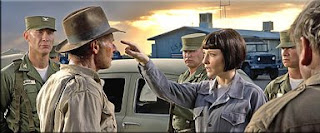


Yes, everything is there: they have made sure that all the elements common to other films of the series are present: punching fights, innumerable chases, humour, the charismatic sidekick, bugs and reptiles, dark catacombs,... Just hearing another character calling Harrison Ford “Dr. Jones”, or having the main theme on the big screen again after such a long wait makes it all worth it.


However, certain aspects of the film deviate from the atmosphere present in the previous three films. A few far-fetched situations, even for Indiana Jones, somehow manage to ruin the credibility of all other things, humanly impossible and still believable, that the character has done in previous films (Indy is not 007!). Some scenes, like the very first one, seem to be unnecessary long and reduce the pace of the film and makes it harder for the spectator to get into the story. And of course, there is what Indy's new adventure is about: it seems to fit perfectly with the others when, suddenly... well, we are taken in a direction where we don't want to go! (you'd better watch and judge for yourself).


Something similar happens with the load of visual effects. Just as we saw in Star Wars, the urge is felt, it seems, of making use and overuse of the new technologies where they hadn't been needed before. The result, rather than Indy, feels more like watching its putative relative, The Mummy. Actors don't seem to get along with the new technologies either and so sometimes they just stand there looking around, unable to interact with the digital part of the set, fact which contributes to a couple of unsuccessful scenes.


One would think that after managing to go on without Sean Connery in the project quite believably, Spielberg would be able to rely on the rest of the cast (Karen Allen, from the first film, among them) to put strong empathetic characters into play, just as he usually does. Sadly, there are quite a few occasions in which the characters either don't seem to know what to say -or how- or they just come into the scene for no reason, and leave as clumsily. The combination of the relationship between the characters and the high level of adventure is not handled as successfully as it would have been expected, and we are left with a certain thirst for more personal moments and less action (and explanations!): moments to show us more of this new, older Indiana Jones, which is taking more and more after his father, or to enjoy Indy's reunion with his very first film girl.


Let's hope this is a momentary lapse for Spielberg's otherwise excellent craft, and that he is not finally listening to Lucas' directing suggestions.


Limited limitlessness: the invisible barrier

.

It all starts. It may take a couple of hours to find your way around. Eventually, though, you find yourself talking to someone, or touching that whatever-it-is object over there.

.

- SIM OWNER: Hey! You can´t be here without wearing a combat HUD!
- POOR NOOB: Sorry, a what?
- SO: Did you not read the notecard?
- PN: I don't know what you are talking about, dancing is the most complicated thing I've learnt so far...
(Noob dances)
- SO: Are you laughing in my face??
(Noob is ejected form the parcel and permanently banned)
- PN: Hey, wait, wait! What is going oooooon!?

.

Have you ever experienced something like this? If you are new to SL, you probably have, in some way or another.

Ever since I started wandering around Second Life, I had mixed feelings about the world and their inhabitants. On the one hand there were all the good (amazing!) things that SL provides us with: a plataform for global communication, a magical place where to turn dreams into (virtual) reality... On the other, I noticed an awkward “something”, silently inherent to the residents and their particular spots: the smell of private property, human liking for possession and prohibitions.

At this stage of development, I don't think there are many people left thinking that the economic dimension of SL has not contributed greatly to its success. This economic dimension entails, of course, private property, boundaries and numerous constraints to the potential of a virtual existence. And this is also why we should not forget that the world itself belongs to every single resident when lifting barriers to seal our properties off. After all, what is the point of being able to fly if you keep running into invisible walls which destroy the illusion of freedom?

.


.

Also, if you are a sim owner and would like visitors to act according to your rules, remember to make them logical, practical and actually possible to obey. Find the way of making it easy for people to "walk" around your place, don't just overuse your power over your own sim for the sake of it. Above all, don't make your guests (sure they are!) remember an awful experience they won't like to repeat.

Let us control our (real life) impulses for (real life) needs that are not necessary in SL and keep it open and magic. As anything new, learning SL may be hard. Let us try to make it enjoyable for everyone, including the newcomers, and not more complicated.

.

Enjoy and let enjoy.

.